Shaw « Deep Packet Inspection

Shaw « Deep Packet Inspection.

I do believe that DPI and related technologies will be abused by ISPs and media conglomerates if they are allowed to do so – and also that they should not have the option to arbitrarily favour one technology over another (as eg when Shaw says that internet delivery is “not a substitute” for cableTV). But technologies like bittorrent and skype do create speed by using extra bandwidth, and this does give the ISPs an opening to claim that they sometimes need to throttle certain kinds of traffic. However that claim is only valid becuse their chosen pricing model does not increase the cost for high bandwidth users. If we do not want to give the ISPs the authority to manage traffic volumes based on content-type (which they will certainly abuse) then we need to accept that bandwidth is a commodity in limited supply and should be paid for on a usage basis. This would have the effect of allowing market pressure to favour technologies which have less impact without giving anyone the power to arbitrarily favour their own technology or content.

Posted in web | Leave a comment

Vaisakhi parade risky for MP Ujjal Dosanjh and MLA Dave Hayer: organizer

Vaisakhi parade risky for MP Ujjal Dosanjh and MLA Dave Hayer: organizer.

I have often enjoyed the Vaisakhi parade, but  the criteria for a parade permit are based largely on the possibility of ensuring public safety.  I wouldn’t want to see this used as an excuse for withholding permission for expression of controversial views, but when the organizers of an event explicitly deny their capacity for or interest in protecting all members of the public then . . .

Posted in bc | Leave a comment

LRB · Joseph Stiglitz · The Non-Existent Hand

LRB · Joseph Stiglitz · The Non-Existent Hand.

One comment in particular rang a bell for me.

Often the use of a mathematical model is considered  as giving predictions greater credibility when all it really does is ensure that they are consistent with the assumptions of the model.

In areas of technology based on well established assumptions this may actually justify some faith in the predictions, but in scientific practice the role of the mathematics is more often not to establish the prediction but rather to pin down the blame for its failure, and so to discredit the faulty assumptions of an inadequate theory.

Perhaps more emphasis on this aspect in our instruction would help to diminish the mystified acceptance of arguments to the effect that “mathematics predicts that…”

Posted in economics, mathematics, politics | Tagged , | Leave a comment

iPod Levy Proposal Makes Sense

Michael Geist – Angus Defends iPod Levy Proposal.

IF the “Canadian solution” of a media levy is valid (and I think it is), then there is no logical reason to distinguish in any way between different types of digital memory. In particular, the memory in an ipod is much more likely to be used for music storage than a randomly chosen CD (which is just as likely to be being used for backup of business records or private photo albums as it is for mp3 storage). I favour the ipod levy as it is totally unacceptable that the CDs used to store my personal photographs be subject to a levy when an ipod used almost entitely to store commercial music tracks is not.

In fact, EVERY bit of digital memory should be taxed at the same rate regardless of whether it is a CD, DVD, ipod or computer hard drive, UNLESS its owner has specifically undertaken not to record copyright content on it. But the proviso is essential and must be equally available on all memory types.

This could be achieved by selling specially marked media and devices (much like the coloured tax-free gas that is often sold for agricultural purposes) –  and if this was available, I for one wouldn’t mind if the penalty for abusing it was quite substantial.

Posted in canada, copyright, technology | Leave a comment

Internet Freedom ~ Stephen’s Web ~ by Stephen Downes

Stephen Downes endorses Hillary Clinton’s recent comments on internet freedom. I especially appreciate his reminder that the value of the internet arises from the participation of all of us, both individually as users and contributors of content, and collectively through the publicly funded research which made it all possible

Posted in uncategorized | Leave a comment

OnLine Educational Resources

Scott Leslie may be on the right track with another 1/4-baked idea – OER “virtual reference librarian” at EdTechPost, but I suspect that it may be less with the idea itself than with the doubt he expresses as follows:

<<Is “discoverability” even actually the problem with resources getting reused, or is it possible that the whole model is so flawed, so disconnected from how educators construct course materials, that it wouldn’t make any difference..?>>

Commenter Mike Caulfield followed up on this with

<<the really interesting thing is how many people said they wanted that, and how few people contact us for help>>

Some educators want a complete package provided by a publisher while others want to develop their own way of engaging students with the material.

In the space between those two extremes it would seem that there was ample room for a style of preparation which involved searching for and combining the best of what is available, and many of us think that is where we belong – but when push comes to shove we bifurcate and either go with a complete package or “roll our own” completely.

As variously a creator, organizer, and user of OERs I think I may have gained some insight into why this is the case.
Continue reading

Posted in education, web | Tagged , | Leave a comment

More copyright irony

This story speaks for itself.

Posted in copyright | Leave a comment

Have a Heart!

It is always interesting when a probability question produces a counter-intuitive result, and the following “glimpse a heart” question is a wonderful example of that:-
Continue reading

Posted in mathematics | Leave a comment

Hard Problems

hardproblemsmovie.com is the website of a documentary made about the US team in the 2006 International Math Olympiad.

<<

Although American students on the whole rank well behind many countries in mathematics, American math Olympiad teams regularly finish among the top teams. While aiming to inspire and entertain, Hard Problems provides an insightful and thoughtful look at the process that produces successful teams, and ultimately, great mathematicians of the future

>>

The first part of the above quote raises some interesting questions about how educational effort should be prioritized.  Does effort directed to strong performance at the top levels compensate for, or compete with, that needed to maintain the basic levels of verbal and mathematical literacy that are needed for effective democratic decision making (as opposed to the woefully ill-informed nonsense that passes for debate about health care in the US for example)?

Posted in education, mathematics | Leave a comment

Mathematical Paintings

From the MathForum newsletter:
<<
David Crockett Johnson was perhaps most famous for his children’s book Harold and the Purple Crayon. From 1965 until his death in 1975, Crockett Johnson painted over 100 works relating to mathematics and mathematical physics. Of these paintings, eighty are found in the collections of the National Museum of American History. They are presented on this site, with related diagrams from the artist’s library and papers.
>>

Posted in uncategorized | 1 Comment

Interesting Poll Results

BBC NEWS | Special Reports | Free market flawed, says survey.

Posted in politics, social issues, world | Tagged | Leave a comment

Why Math?

A couple of recent additions to the arsenal of reasons for promoting mathematics education are this recent article by Ian Stewart in the UK Telegraph and the collection of ‘Math Matters – Apply It’ posters developed by SIAM (the Society for Industrial and Applied Mathematics).

Posted in education, mathematics | Leave a comment

Stanford Study of Writing

The Stanford Study of Writing provides a welcome counterpoint to some of the nonsense that has been put about regarding impact of the internet on literacy.

Posted in education, technology | Tagged , , | Leave a comment

Crossing the Finish Line: SATs and GradRates

Stephen Downes points to Chad Adelman posting on Crossing the Finish Line – a recent book about university graduation rates by William G. Bowen, Matthew M. Chingos & Michael S. McPherson.

I haven’t read the book but am suspicious of any attempt to draw conclusions about social policy from statistical analysis – especially in reviews and commentaries that isolate particular statements about how variables are correlated (and even more so if they include references to “predictive power” going “below zero”, since statistical power is defined as a probability and  a correlation of minus one has a very strong predictive power in any reasonable sense of the term).

A common “paradox” pointed out to students in an introductory statistics course is that it is possible to have a variable S (for, say, SAT score) that is positively correlated with some measure, say G, of success (eg graduation) in each of several subsets making up the whole of a population – while being negatively correlated in the population as a whole.

One way this might happen, for example, would be if there was a characteristic I (for, say, Inspiration) which was very highly correlated with G, and such that among the high I part of the population S was only weakly correlated with G but in the low I population S was very strongly correlated with G.

If among the population as a whole (in this case university entrants) low I was correlated with high S, then entrants with high S would be more likely to be in the low I group and so less likely to graduate and so S might be negatively correlated with G – even though in each of the low and high I groups separately, higher S does contribute to increasing G.

Of course, many readers of this  (if in fact there were any) might then say “but if I is the best predictor of G, let’s just use it and forget about S”.

And maybe they are right.  At least if the goal is soley to maximize the G rate we should just ignore the low I group and concentrate all of our efforts on those with the magic I factor.

If only we could identify it we could do away with all that “high stakes testing” and give our attention to those who deserve it.

Well the good news is that I have found I.

The bad news is that it is not Inspiration.
Continue reading

Posted in education, social issues | Leave a comment

Media Democracy Day Vancouver – November 7, 2009 | Media Democracy Day

Media Democracy Day Vancouver – November 7, 2009 | Media Democracy Day.

Posted in uncategorized | Leave a comment

A Widening Gap

The Back Page article by Joseph Ganem in this month’s APS News suggests that nominal content and student capability outcomes in US high school mathematics are moving in opposite directions – and attributes this largely to attempts to introduce abstract topics before the students are ready.

Posted in education, mathematics | Leave a comment

Blog Action Day

This year’s Blog Action Day is devoted to the theme of Climate Change and an understanding of mathematics is certainly essential for anyone involved in making making decisions about how to respond to this issue (which in a democracy is presumably all of us).

The choice of Math and Climate as the theme of this year’s Math Awareness Month emphasized this connection, and Murray Bourne at squareCircleZ  today points to a number of articles in which he has used related topics as a source of examples for teaching mathematics.

A good source of background on the science of CO2 related climate change is this excellent history prepared by Spencer Weart at the American Institute of Physics, as is also the RealClimate site managed by a team of well-reputed climate scientists, and the question of how to compare the effectiveness of different policy choices is addressed in this on-line book by UK physicist David McKay (reviewed by theRegister).

The fact that no amount of restraint or conservation can counterbalance the harmful effects of increasing population is not often noted in the CO2 debate so I was a bit disappointed that Murray did not include his discussion of that topic in his list.

Posted in climate, mathematics, web | Leave a comment

FAQ for Universities Interested in WPMu

Since my institution has started using WPMu for faculty and departmental websites I had better have a look at this from bavatuesdays (which came to me  via Stephen Downes).

Posted in education, WordPress | Leave a comment

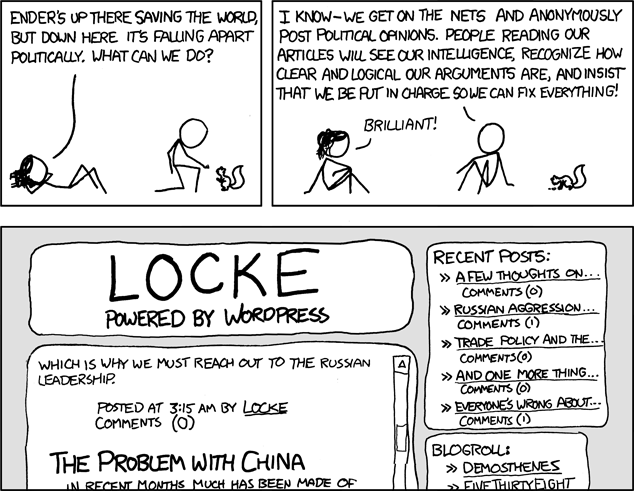
xkcd – A Webcomic – Locke and Demosthenes

xkcd – A Webcomic – Locke and Demosthenes.

about this

Posted in uncategorized | Leave a comment

How to remember trig ratios

Inventing cute mnemonics is fun, and the process of inventing and checking them may help reinforce the definitions, but beyond that they really are useless – and I believe they do more harm than good when people actually try to use them.

It takes much more time (and mental effort) to correctly recall and decode one of  these than anyone who needs to use the terms can afford. And there is a much better way.

Just think ‘Sine is the Side’ or  ‘Cos goes Across’ (we don’t need both)

This takes negligible time to decode, reinforces the concept directly, and is immune to the vagaries of failing memory. (Was that “Odd Aged Teachers Are Happy Campers On Hot Sundays” or “All Old Teachers, Happily Out Camping, Have Amnesia Sometimes “?)

Posted in education, mathematics | Leave a comment